

Tape out on time, with proof.
Raiton carries a design from its first architecture to signed-off RTL, and brings its own verification tools to the work. What you receive is fixed in price, reproducible in evidence, and whole: one partner for the entire front end.
Four promises a front-end partner must keep
Headcount is easily bought. Certainty of schedule, proof of power and safety intent, and a report that survives an audit are not. Those are what we sell.
Triage in hours, not days
A regression arrives as one view: the failure bins, the first error, the waveform at that instant and the RTL line that caused it. Our engineers debug in our own Debug Studio, so your schedule never waits in a licence queue.
Power and safety intent proved, not sampled
Isolation, retention, power states and every safety mechanism receive formal proofs on top of simulation. The bugs that reach silicon are the ones no one wrote a test for; those paths we prove.
Fixed price, no licence top-ups
Readiness reviews and sign-off packages are quoted at a fixed price per block. Power-aware and safety checks run on our own tools, so no further EDA seat stands between you and the result.
Every report reruns with one command
You receive the environment, the proofs and the campaign, not merely a PDF. A director reviews every engagement each week and joins the call whenever you need them.
The language your engineers already speak
Power intent as UPF, properties as SVA, results as waveforms with their driver trace attached. Nothing hides behind a slide.
// isolation clamp must hold whenever PD_MEM is off
property p_iso_clamp_when_off;
  @(posedge clk) disable iff (!rst_n)
  !pd_mem_pwr_on |-> (mem_rdata_iso == '0);
endproperty
a_iso_clamp: assert property (p_iso_clamp_when_off);   // PASS, full proof

# power intent, applied natively by the simulator
create_power_domain PD_MEM -elements {u_mem}
set_isolation iso_mem -domain PD_MEM -clamp_value 0 \
   -applies_to outputs -isolation_signal iso_en
set_retention ret_ctrl -domain PD_MEM -save_signal save \
   -restore_signal restore
add_power_state PD_MEM -state OFF {-supply_expr {VDD_MEM == OFF}}

// trace @ 905 ns: u_ctrl.cfg = zzzzzzzz (retained)
//   <= always_ff @(posedge save)  upf:42  set_retention ret_ctrl
//   under PD_MEM_pwr_on = 0     src rtl/ctrl.sv:149
Where our engineers have earned their place
The client names remain under NDA. The programmes do not.
From an idea to tape-out-ready RTL, one partner
Most vendors occupy one box on this line and hand off at its edges. We hold the whole line: one team that knows what the next stage will ask for, and a director who owns the outcome.
Architecture
Specification, micro-architecture, performance models, hardware and software partitioning.
RTL design and integration
Synthesisable RTL, AMBA interconnect and IP integration, lint, CDC and RDC clean.
Design verification
Plans, UVM environments, constrained random, coverage closure, gate-level simulation.
Formal verification
Property checking, equivalence, mutation coverage, formal apps and sign-off criteria.
Low-power verification
UPF review, static checks, power-aware simulation, formal proofs of the power logic.
Functional safety
Safety mechanism proofs, fault injection, ISO 26262 metrics, lockstep equivalence.
FPGA prototyping and post-silicon validation
Real software on the RTL months before tape-out; board bring-up, stress tests, lab debug, findings fed back to design.
Embedded software and bring-up
Bootloader, BSP, RTOS and Linux, drivers and wireless stacks, first boot on FPGA and on silicon.
We build the tools we verify with
Verification is slow wherever the tools stop short: no native power intent, no path from a bad waveform back to its RTL line, no single view in which to triage a regression. We built the missing pieces, we use them on every project, and we let evaluation partners run them on designs of their own.
Power-aware simulator
UPF applied natively at compile time: isolation, retention, level shifters, switches and power-state tables. Open-source core, no extra seat.
Learn more →Debug Studio
Waveforms with power lanes, one-click driver trace to the RTL line, UVM objects and transactions, assertion and regression triage in a browser.
Learn more →Formal UPF and safety suite
Static and formal UPF checks, fault-injection campaigns with ISO 26262 metrics, lockstep equivalence. UPF and netlist in, report out.
Learn more →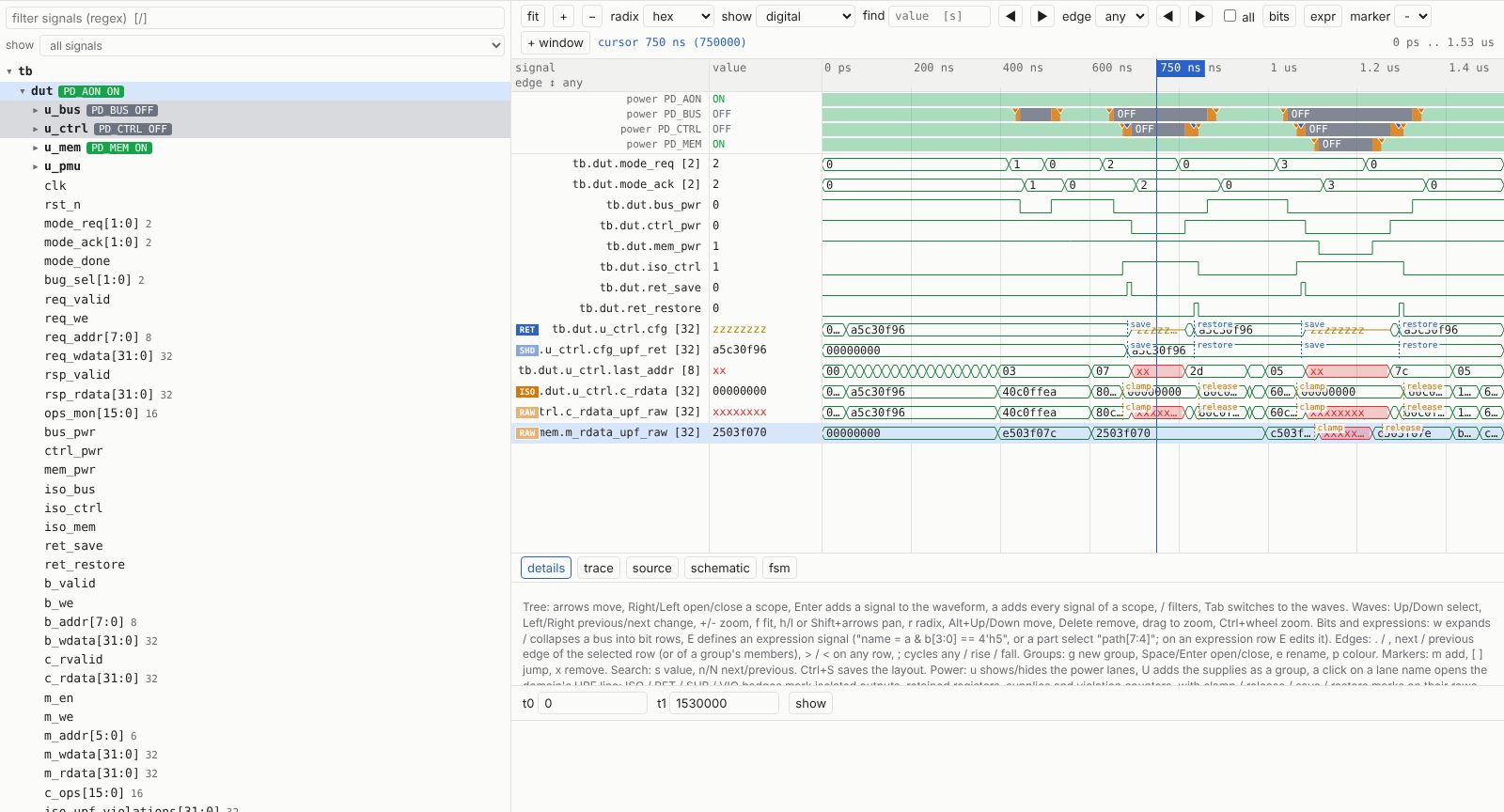
From specification to signed-off RTL
Plan from the specification
We read the spec with your architects and return a verification plan with every feature mapped to tests, coverage and, where it pays, a formal property. You see the scope before you sign.
Build the environment
UVM agents, scoreboards and reference models, or formal harnesses, built to run in your tools and in our open-core flow. Weekly demo to your lead.
Run and triage at speed
Regressions land in one view: failing bins, first error, the waveform at that point, and the driver trace to the RTL line that caused it. Bugs reach your designers with the fix location attached.
Prove the hard parts
Power states, isolation and retention, safety mechanisms, arbiters and bridges get formal proofs, not just tests. These are the escapes that cost a respin.
Sign off with evidence
Coverage closure, proof logs, campaign metrics and a report your reviewer can audit and rerun. Handover includes the environment and a recorded walkthrough.
Measured on our own silicon, before we ask for yours
We verify our own designs on open-source cores to sign-off depth, so that the work can be shown in full before you share a single file of yours.
Begin small; scale when the evidence arrives
Expertise scaled to the phase of the programme, its urgency, and how much of it you wish to own.
Readiness review
Two weeks, fixed price. Your UPF or safety concept and RTL in; static and formal checks run; a prioritised findings report with reproducible evidence out. The lowest-risk way to see how we work.
Get a quote →Managed work package
Outcome-led scope with Raiton ownership: plan, environment, regression, coverage closure and an audit-ready report for an IP or subsystem. Fixed price, milestone invoicing.
Scope a package →Embedded pod
A ready team inside your programme, in your flow and tools, from architecture to post-silicon, with our tooling brought along and a director reviewing the work weekly.
Discuss a pod →Specialist augmentation
Targeted senior capability where it is needed: formal, low power, functional safety, PCIe, RISC-V, firmware. Weeks, not quarters.
Ask for a specialist →Build, operate, transfer
We stand up a verification or firmware capability for you, run it to a steady state, then transition the team and the flow into your organisation.
Plan a transition →Tool evaluation partnership
Run our power-aware simulator, Debug Studio and formal suite on your design with our engineers onboarding your team. Evaluation partners shape the roadmap.
Request evaluation →NDA and a 30-minute call
You describe the design and the deadline. We tell you what we would check first.
Scoped proposal
Fixed price, named engineers, milestone dates, and the report format you will receive.
Readiness review delivered
Findings with waveforms and RTL lines, reviewed live with your team.
Scale on evidence
Sign-off package or embedded team, with the same engineers who did the review.
Two weeks in which there is nothing to lose
- NDA signed before any file moves; delivery inside your network when the design cannot leave it.
- Readiness review at a fixed price, with the findings yours to keep whether or not you continue.
- Tool evaluations run on your machines, on your design, with our engineers onboarding your team.
- Named director on every engagement; weekly review, one-working-day response.
- You keep the environment, proofs and campaigns. No lock-in to our tools: everything also runs in yours.
"If the review finds nothing worth fixing, you will know in two weeks and for a fixed fee. If it does, you will have the waveform, the RTL line and the proof before anyone has to argue about it."
Kavinkumar Darwin, Director