

Reference projects, with the numbers behind them
Client programmes described without their names, and reference designs of our own on open-source cores, verified to sign-off depth so that the work can be shown in full.
Client work, the names withheld under NDA
Five programmes from recent years, told the way they may be told in public.
Multi-engine AI accelerator subsystem with evolving specs, deep data paths and coverage risk.
Built scalable UVM environments, an assertion strategy and coverage-led regression closure.
Faster debug cycles, clearer risk visibility and a predictable verification sign-off.
Automotive SoC with safety islands, power domains and a mixed reset strategy.
UPF checks, X-propagation, isolation and retention verification, CDC and RDC, fault campaigns.
Reduced escape risk where power transitions and safety mechanisms intersect.
200+ core configurations, single core to 16-core multi-cluster, each needing a correct BSP and validated software on every RTL drop.
Owned the BSP generator and validation suite with CI/CD; root-caused failures across simulation and FPGA, working daily with RTL, DV and physical design teams.
Every configuration shipped with validated software; faster field customisation and tighter silicon-software alignment at release.
Bluetooth 5 LE host stack and GATT profiles, Wi-Fi host driver on Linux and RTOS, and an IoT gateway reference platform with cloud connectivity.
Designed, ported and qualified the stacks across Windows, Linux and FreeRTOS; customised profiles per customer; built open-source starter kits.
Customers evaluated and designed in the MCU faster, with production-ready software reducing their own integration effort.
A vector-engine MCU family needed BLDC motor-control firmware for a leading power-tool maker, plus on-device ML and IIoT 4.0 (TSN) demonstrators.
Stood up a motor-control team from scratch; delivered the firmware, ported and optimised ML algorithms to the MCU, built the TSN proof of concept.
Silicon differentiators became demonstrable in weeks, giving sales a working reference and customers a validated starting point.
Safety wrapper for a RISC-V processor subsystem
A safety wrapper around an open-source RISC-V core that adds the safety mechanisms an automotive microcontroller needs, then proves each one.
What was built
- ECC on instruction and data buses with fault injection hooks
- Address and control parity on bus requests, parity on response handshakes
- Delayed lockstep with a full shadow core, dual comparators and a built-in self-test
- Fault collection unit with a dual-rail alarm
- Safety manager state machine with safe state encoding
- Triple modular redundancy and parity on all safety-logic state
- Memory-mapped registers so firmware can inject faults and read the fault log
- AXI4 bridges carrying integrity bits in the user signals
What the proofs found
The formal proof of the bus-integrity block caught a real weakness: a parity computed over a derived signal missed a flipped valid whenever the error bit was also set. Parity now covers the raw signals. A 4-state UVM run later caught an X on the same path that a 2-state simulator can never show.
Results
| Directed tests, with and without safety enabled | 196 + 196 |
| Formal proof tasks across all mechanisms | 39 of 39 pass |
| RTL mutants killed by the property set | 58 of 58 |
| Simulation mutants killed | 12 of 12 |
| Fault-injection campaign runs | 510 |
| UVM regression on a commercial simulator | 995 of 1,000 pass |
| Unexplained failures | 0 |
The five UVM failures are known test-versus-core incompatibilities that fail identically on the unmodified core; one is the wrapper turning an uncorrectable error into a bus error by design.
Multi-domain low-power memory controller
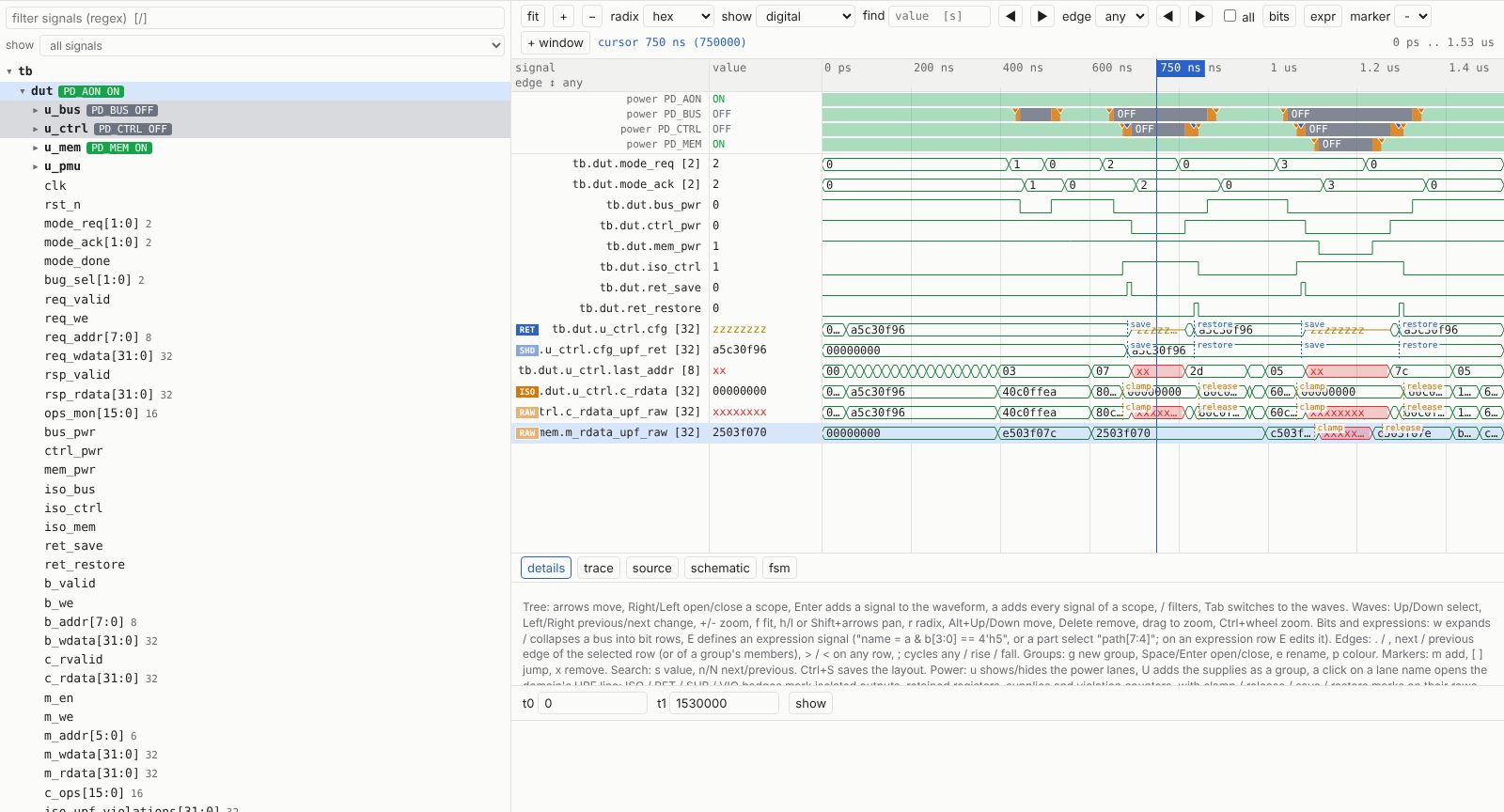
A memory controller split into always-on and switchable power domains, with a UPF describing switched supplies, isolation, retention and a power-state table. Verified entirely under power-aware simulation with our own simulator, with no hand-written power models in the testbench.
- Registers in a powered-off domain are corrupted and shown as X on waveforms
- Isolated outputs clamp to their UPF clamp value while the domain is off
- Power-state table transitions are checked against the UPF at run time
- Every finding links back to the RTL line through the source map
The same UPF is parsed by our static checker with zero unknown commands and a clean rule report, and it drives the formal properties for isolation, retention and power states.
Results
| Test suites under power-aware simulation | 10 |
| Checks passing with corruption and isolation active | 3,770 |
| Power-state table violations | 0 |
AXI4 interconnect and RISC-V subsystem
AXI4 interconnect
Crossbar with ID-based routing, outstanding-transaction tracking and width conversion, verified with a smoke testbench and a UVM environment with routing tests on commercial and open simulators. The UVM runs found crossbar ordering and downsizer bugs that the directed tests had missed.
RISC-V subsystem with peripherals
Self-contained RTL, testbench and scripts for a RISC-V core with peripheral blocks: block-level tests and C programs running on the core, passing on two open-source simulators.
Formal techniques beyond property checking
An eleven-lesson course built on one reference design, with every result reproduced on open-source tools. It is the material we use to train engineers and the reference for how we run formal sign-off.
- Property checking
- Equivalence checking
- Mutation coverage
- Datapath proofs
- Protocol models in TLA+
- Formal apps: dead states, connectivity, X-reset
- Fault injection
- Information flow
- Abstraction
- Theorem proving
- Sign-off
Results
| Mutation coverage | 57 of 60 mutants caught, 3 equivalent |
| Protocol model state space explored | 918,621 states, no error |
| Sign-off rows matching expectation | 27 of 27 |
The same report, for your design?
A readiness review takes two weeks and yields exactly this kind of evidence on your own RTL.
Request a review →